
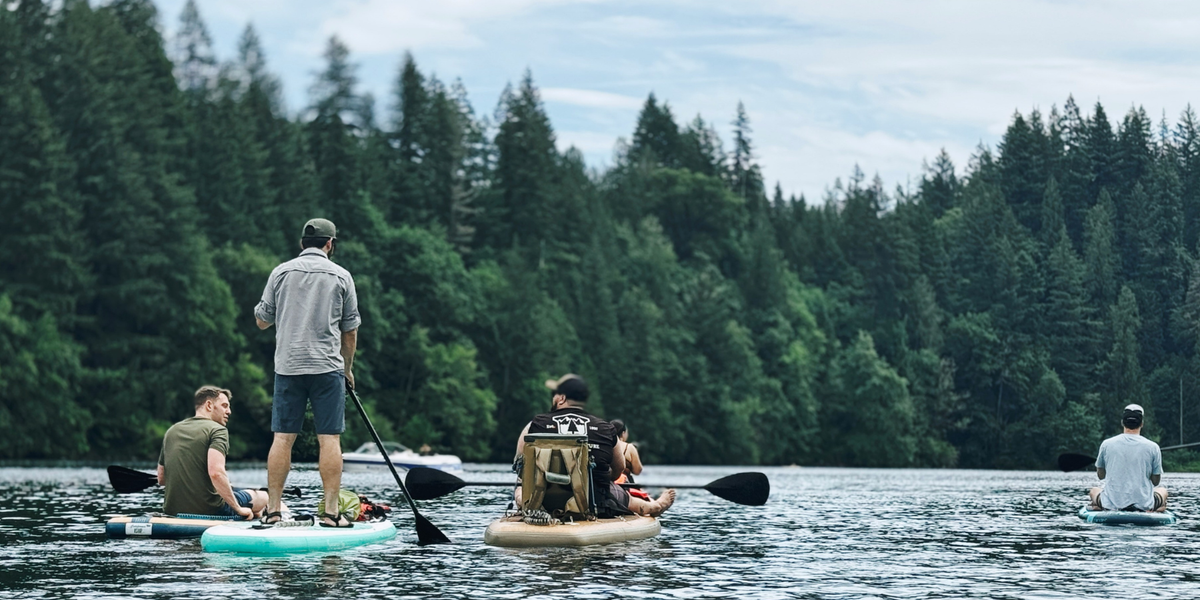
Organizing a paddleboard outing with friends, family, or a group of young people can quickly become a challenge: some are discovering stand-up paddleboarding, while others already want to travel several kilometers.
How can you satisfy everyone without boring the experienced ones or discouraging the beginners?
The solution isn't necessarily to separate the participants! With a suitable route, accessible games, and good organization, differences in skill levels can even enrich the experience.
Here are 8 tips for a successful group SUP outing, whether with friends, family, a school, a community center, or a summer camp.
1. Evaluate skill levels, but especially expectations
Before forming groups, ask three questions:
-
Comfort in the water: Knowing how to swim doesn't necessarily mean being comfortable on a paddleboard.
-
Desires: A quiet stroll, exploration, games, or a physical challenge?
-
Physical abilities: Endurance, mobility, and apprehensions also influence the experience.
We generally distinguish three profiles, each with their own needs:
-
Beginner: Build confidence and progress without pressure
-
Intermediate: Develop autonomy and explore
-
Experienced: Take on challenges and perfect technique

2. Choose a route adapted to different levels
For a group paddleboard excursion, favor a calm body of water, sheltered from the wind, with an easy entry point and several options to return to shore.
Our tip: the petal route
Rather than one long crossing, imagine several small loops around a single gathering point:
This organization allows you to adapt distances without imposing the same pace on everyone. Each sub-group must, however, have appropriate supervision.
To learn more, discover how to plan a family paddleboard adventure, from choosing the location to the gear to pack. (Article in English.)
3. Match the boards to the participants' levels
A poorly suited board can turn an enjoyable introduction into a frustrating exercise.
For beginners, choose an all-around board, which is stable and suited to the participant's size.
For experienced riders, a longer, streamlined touring board can offer more glide, but be mindful of speed differences!
And why not stay seated? A hybrid board like the Retrospec - Weekender Plus allows for seated use with the right equipment.
Also remind participants that staying on their knees or sitting down is perfectly acceptable, even for the entire outing. The goal is to enjoy the water, not to succeed in standing up at all costs.
4. Offer paddleboard games for all levels
The secret to a successful water activity? The same game, but with different challenges based on skill level!
The challenge course
On a small, safe circuit, beginners paddle on their knees, intermediates perform turns while standing, and the advanced riders use specific mandatory paddling techniques.
The balance challenge
Beginners try to stand up, intermediates gently change positions, and the experienced ones work on their footwork on the board or practice pivot turns in an appropriate area.

The observation rally
Turn your excursion into a scavenger hunt: birds, aquatic plants, rock formations... An ideal activity for families and groups of children.
The technical slalom
Set up a few safe markers. Beginners learn to steer their board while others try to complete the course with as few paddle strokes as possible.
The collective mission
Give the group a common goal: succeed in several challenges or complete an observation circuit. In this case, the fastest one doesn't win—the whole team does!
5. Keep the group together without forcing the same pace
Before hitting the water, define navigation limits, visible gathering points, and a common signal to regroup.
For large groups, a supervisor at the front and another at the back can help maintain cohesion, if conditions and communication tools allow.
Also, have a plan in place to accompany anyone who wishes to return early.
The goal: to allow everyone to progress comfortably without leaving anyone isolated or out of sight.
To help beginners, also check out these tips for introducing friends to paddleboarding.
6. Plan breaks before fatigue sets in
On the water, fatigue sometimes creeps up unnoticed: less efficient paddle strokes, loss of concentration, a participant slowing down, or a discouraged child.
For an introductory outing, consider a first break after 15 to 20 minutes, then adapt according to the group.
Take the opportunity to drink water, have a snack, and check that everyone wants to continue. A dry bag allows you to carry water, snacks, and a change of clothes.
Our advice: It's better to take a break too early than to deal with a difficult return trip!

7. Adapt safety to the least autonomous participant
Navigation conditions must suit the entire group, not just experienced paddlers.
Before a paddleboard outing, check:
-
The weather: wind, currents, water temperature, and return options.
-
The PFD: every participant should wear a suitable life jacket.
-
The floating rescue rope: a floating throw bag can be tossed to a person in difficulty to help them reach a safe spot.
-
Participants' abilities: swimming comfort, getting back on the board, and understanding of instructions.
-
Supervision: competent personnel, communication means, monitoring, and rescue procedures.
The safety leash must also be suitable for the environment: an ankle-attached leash can be dangerous in currents where there is a risk of snagging.
For schools, summer camps, and organizations, include necessary authorizations and supervision procedures for minors.
8. End the outing by making them want to come back
A successful outing isn't measured by the number of kilometers covered, but by the enjoyment everyone had on the water.
For a beginner, managing to stand up for a few seconds can be a victory. For an experienced paddler, mastering a new turn can be just as rewarding.
Before finishing, ask the participants about their favorite moment and what they would like to try next time.

Organize a SUP outing with the right equipment
Whether you are preparing an activity for friends, family, or for a school, campsite, or organization, SUP Montréal can help you choose boards and accessories tailored to your participants.
For a one-off outing, discover our take-away paddleboard rental service, allowing you to explore in a group wherever you wish.
Do you organize water activities regularly? Discover our purchase and rental solutions for fleets of paddleboards for schools, camps, and organizations.
Because the best paddleboard outing is not the one where everyone goes at the same speed, but the one where everyone finds their place on the water.