
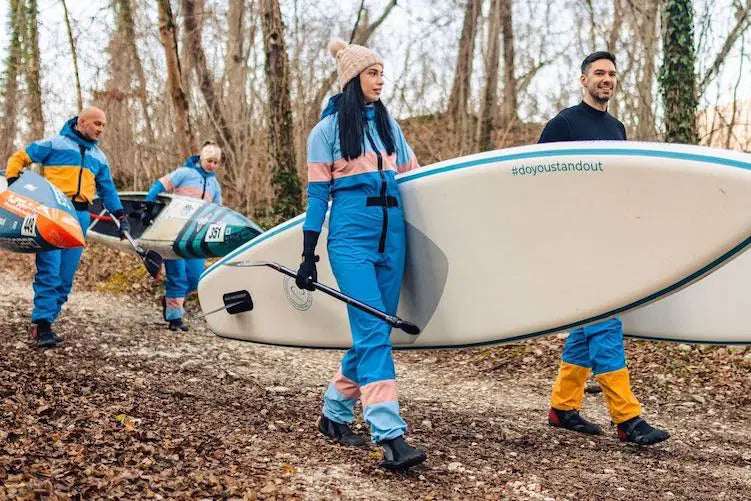
Cold water drysuit and gear guide
White shores, an almost empty body of water, mirror reflections, and that calm rarely found in mid-summer: cold-weather paddleboarding offers a completely different atmosphere.
That’s precisely what makes you want to keep paddling when temperatures drop.
But to enjoy it comfortably and more safely, you need to adapt your gear. And when the water gets truly cold, the drysuit becomes one of the most important pieces of equipment.
What is a drysuit used for?
The main role of a drysuit is simple: to keep the water out.
Unlike a neoprene wetsuit, which is designed to function even when wet, the drysuit creates a waterproof barrier around the body.
However, there is one essential thing to remember:
the drysuit keeps you dry, but it is the layers worn underneath that keep you warm.
That is precisely what makes it very versatile for SUP. You can adapt your insulation based on air temperature, water temperature, wind, and the intensity of your outing.
Drysuit or wetsuit?
The wetsuit relies on neoprene and works with a thin layer of water trapped against the body.
The drysuit, on the other hand, seeks to prevent water from entering.
For paddleboarding, where you normally spend much more time on the water than in it, the drysuit allows you to stay dry and adjust the layers worn underneath much more easily.
How does a drysuit stay waterproof?
Waterproofing relies on several elements working together.
Neck and wrist gaskets
The gaskets are essential as they prevent water from entering at the openings of the suit.
Depending on the model, they can be made of latex, neoprene, or other synthetic systems.
Latex gaskets are very waterproof, but they can feel quite tight when they are new.
They must be fitted snugly against the skin, without any gap allowing water to pass through, but they should never cut off circulation, cause dizziness, or create excessive pressure.
Over time, the gaskets generally become more flexible and comfortable.
If a gasket feels truly too tight, it is better to follow the manufacturer's recommendations before attempting to modify it. An improper cut can weaken the gasket or cause a tear.
Integrated booties
Many drysuits have waterproof booties directly integrated into the suit.
This is particularly practical because your feet stay dry even when walking in shallow water.
These booties are not, however, designed to be used on their own.
You must wear booties or suitable shoes over them to protect the fabric from abrasion and to have enough grip on the board and on the banks.
How should a drysuit fit?
A drysuit should not be fitted like a neoprene wetsuit.
It must remain loose enough to allow for thermal layers underneath and to maintain great freedom of movement.
For SUP, you mainly need to check the reach.
Before choosing a size, it is useful to mimic a few simple movements:
-
raising your arms as if planting the paddle
-
performing a full paddling stroke
-
crouching
-
kneeling
-
rising up as if standing back up on the board.
The suit should not pull tightly at the shoulders, back, or crotch.
If it becomes difficult to raise your arms or crouch, it is likely too small or too short.
A little extra volume is therefore completely normal with a drysuit.
What to wear under a drysuit?
Since the drysuit provides little insulation on its own, the clothing worn underneath makes a huge difference.
The base layer should be breathable and capable of wicking away moisture, such as a technical synthetic or merino wool layer.
When conditions become colder, you then add an insulating layer:
-
light fleece
-
thermal pants
-
breathable mid-layer.
It is better to use several adjustable layers rather than a single very thick garment.
This allows you to easily adapt your gear to the conditions and avoid sweating too much when paddling hard.
Cotton should be avoided, as it absorbs moisture and quickly becomes cold when damp.
Can you swim in a drysuit?
A drysuit is primarily designed for activities where you remain mainly on the water, such as paddleboarding, kayaking, or canoeing.
It is possible to swim a short distance if necessary, for example, to reach your board or the shore, but it is not a garment designed for sports swimming.
Its loose fit creates more resistance in the water than a wetsuit.
That is one more reason to stay close to your board and choose a route adapted to the conditions.
Keeping your feet warm
Even with integrated waterproof booties, feet can quickly get cold.
Thermal socks worn inside the drysuit can be very useful, provided they do not compress the foot too much.
On the outside, neoprene booties are particularly well-suited for SUP.
They protect the drysuit's booties, provide grip, and add a layer of insulation.
They must, however, remain flexible enough to maintain good feel underfoot.
Keeping your hands warm
Hands are directly exposed to the wind, spray, and the cold paddle shaft.
On merely cool days, windproof or waterproof gloves may be sufficient.
When temperatures drop further or the risk of immersion increases, neoprene gloves generally offer better protection.
The most important thing is to retain enough mobility to hold the paddle correctly and handle your safety equipment.
What about your head?
Good head protection significantly changes your comfort level.
A warm, well-fitted beanie is very suitable for many situations.
When the risk of immersion becomes greater, a neoprene hood or cap offers protection better suited to cold water.
In any case, it is better to choose something that stays securely in place and does not hinder movement.
Always plan for dry clothes
Even with a good drysuit, it is best to plan for a set of warm, dry clothes in a dry bag.
A sweater, pants, socks, and a warm layer can become very useful if the outing must be cut short.
A warm drink and a small snack are also easy to add and very much appreciated when finishing an outing in cold weather.
Durability and maintenance
A drysuit is a piece of equipment you want to keep for a long time.
The quality of the fabric, seams, zippers, and gaskets is therefore very important.
Over time, certain elements may wear out, particularly the neck and wrist gaskets.
The advantage is that they can generally be replaced, which significantly extends the life of the suit.
After an outing, it is important to properly dry the drysuit, check the gaskets and zippers, and follow the manufacturer's care recommendations.
Before your first outings, it is also useful to take the time to learn how to put it on properly, close the waterproof zippers completely, and verify that everything is correctly positioned.
The rest of the gear
The drysuit remains the central piece for cold-water paddling, but it must be part of a consistent set.
You must also plan for:
-
a correctly adjusted PFD
-
a leash suited to the environment
-
a phone protected from water and attached to your person
-
a change of dry clothes
-
a board, paddle, and fin in good condition
For your first cold-water outings, it is best to stay close to the shore, choose a short route, and paddle with someone else.
Why we chose Level Six
For our first drysuit selection at SUP Montréal, we wanted a brand that truly understands paddle sports and designs its products around their movements.
We therefore chose Level Six, a Canadian company specializing in kayaking, canoeing, and paddleboarding.
Their suits are designed to allow a full range of motion, but also to last and to be maintainable or repairable when certain parts wear out.
We have selected two models.
The Level Six Loki focuses heavily on comfort, notably thanks to its latex-free gasket system at the neck and wrists. It is a particularly interesting option for those new to drysuits or who want to extend their season with maximum comfort.
The Level Six Freya is more technical and features a cut specifically developed for the female form. Its articulated construction promotes excellent freedom of movement for paddling, crouching, and moving on the board.
Both models are now available for purchase at SUP Montréal.
They are also offered for rent for those who wish to try winter paddleboarding for the first time, test a drysuit before buying their own, or simply plan a few outings during the cold season.
Because with the right gear, white landscapes, calm water, and mirror reflections are no longer just something you watch from the shore.