
Paddling, maintaining, and storing your board
The end of summer doesn’t necessarily mean the end of paddleboarding.
Autumn often offers some of the most beautiful outings of the year: colors reflecting on the water, fewer crowds, and bodies of water sometimes smooth as glass. Then, winter completely transforms the landscape with its white shores, silence, and an atmosphere you can’t find at any other time of the year.
So, what should you do with your paddleboard when the cold season arrives?
Keep paddling… or take advantage of the winter to thoroughly clean, inspect, repair, and store your board until spring.
Keep paddling in the fall
Autumn is a magnificent season for paddleboarding.
The days can still be mild, but you must start paying more attention to water temperature, not just air temperature.
As the water cools down, a wetsuit suited for the conditions, neoprene booties, and a PFD quickly become valuable allies.
It is also the perfect time to see the colors from a different perspective: from the water.
And why not try winter paddleboarding?
For those who are highly motivated, the season can last much longer.
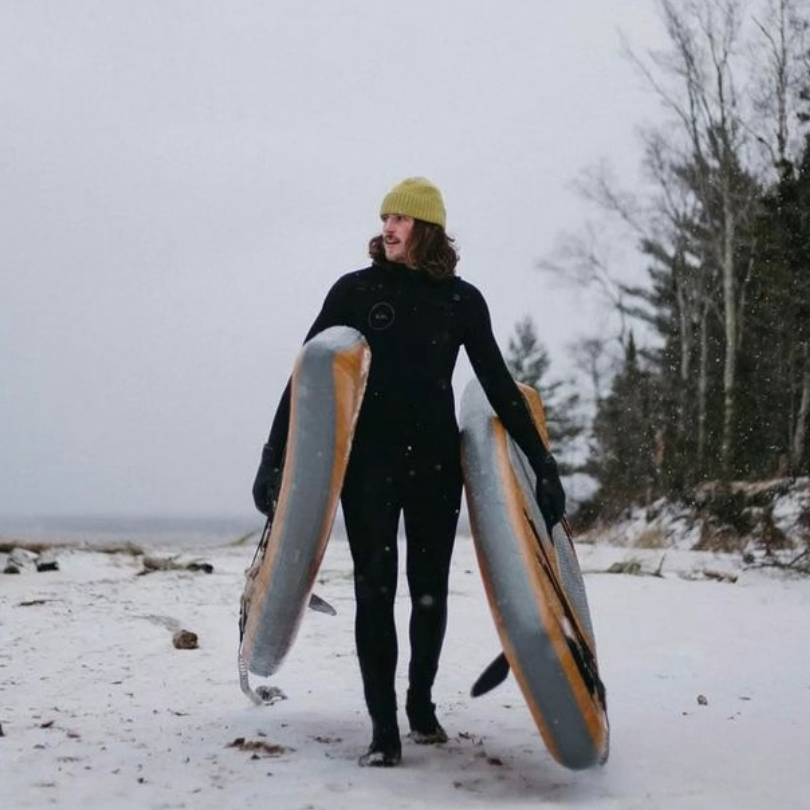
Paddling surrounded by white landscapes, on calm water with almost no one around, offers a completely different experience.
When the water becomes very cold, a drysuit becomes particularly valuable.
Unlike a wetsuit, its purpose is to keep water out. The drysuit keeps you dry, while thermal layers worn underneath keep you warm.
At SUP Montréal, we now offer Level Six Loki and Freya drysuits, available for purchase but also for rent for those who want to discover winter SUP or only head out for a few trips during the cold season.
To learn more, check out our guide: Winter Paddleboarding: Why Choose a Drysuit?
Marie-Ève Ricard has also dedicated a full article to the subject, featuring 7 essential things to know for winter SUP.
Is your season over? Inspect your board before storing it
Before putting your paddleboard away for several months, take a few minutes to examine it thoroughly.
On an inflatable board, check the following:
-
the rails
-
the valve
-
the glued seams
-
the deck pad
-
the handles
-
the attachment points
Inflate your board and verify that it holds pressure properly.
If you suspect a small leak, a very simple method is to apply soapy water to the suspect area. Small bubbles forming will often help you locate the leak.
If air seems to be escaping around the valve, it might just need to be tightened with a specialized wrench.
It’s better to discover a small problem in the fall than on the morning of your first outing in the spring.
Take the opportunity to maintain your pump and accessories
After a full season, your manual pump also deserves some attention.
If it becomes harder to operate or seems less efficient, it may be worth checking the piston and its seals. On many models, cleaning followed by a small amount of appropriate lubricant helps restore smoother operation.
Take the time to also inspect:
-
the pump hose
-
the pressure gauge
-
the leash
-
the fin
-
the paddle
-
attachments and accessories
A worn part or a small repair is much easier to address leisurely during the winter than at the start of the next season.
And if you have any doubts, you can also have your equipment inspected or repaired at SUP Montréal.
Cleaning and, above all, thoroughly drying your board
Before storage, two steps are essential:
clean and dry.
Rinse the board to remove sand, dirt, and residue accumulated during the season.
Clean the fin, leash, and accessories as well.
Then, let everything dry completely.
An inflatable board stored while damp for several months can develop odors or mold. Pay special attention to the underside of the board, the deck pad, the folds, and the inside of the bag.
Do not close the bag until everything is completely dry.
Should you deflate your paddleboard for the winter?
Not necessarily, but for the majority of inflatable paddleboard owners, storing it in its bag remains the most practical solution.
Once clean and dry, the board can be deflated and rolled without compressing it excessively.
If you have enough space, some owners also choose to keep their board slightly inflated.
In any case, where it is stored is probably even more important than the method chosen.
How to store an inflatable paddleboard at home?
Ideally, choose a spot that is:
-
dry
-
clean
-
out of direct sunlight
-
protected from extreme temperature fluctuations
-
without excessive humidity
A dry basement or indoor storage space is usually very suitable.
A damp shed or a location subject to freezing, thawing, and significant temperature changes is less ideal for multi-month storage.
Also, avoid placing heavy objects on top of the bag.
How to store a hard paddleboard?
A rigid board requires a little more attention… and especially much more space.
It should be kept in a dry and protected area, ideally on proper racks that distribute its weight evenly.
Avoid letting the board rest for months on a small surface area or placing heavy objects on top of it.
And when talking about an 11, 12, or even 14-foot board, the main problem quickly becomes obvious: where do you put it all winter?
Store your paddleboard at SUP Montréal
If you are short on space at home, we now offer a winter paddleboard storage service in Montreal, from October 1st to May 1st.
Your board is kept indoors, in a secure and heated space, and you pick it up in the spring.
Inflatable paddleboard
$69 + tax for the winter.
Simply bring your board clean, dry, and packed in its bag.
Hard paddleboard
Starting at $149 + tax for the winter.
The board is tagged, photographed, and kept on a suitable rack until spring.
A practical solution to free up space at home and avoid having your paddleboard spend months in a garage or shed.
You bring it to us in the fall. You pick it up in the spring.
Discover our storage service in Montreal
Take advantage of winter to prepare for the next season
Winter is also a good time to replace what needs replacing.
A worn-out leash, a damaged paddle, a pump that isn't performing well, or a small leak are easy to forget when the season is in full swing.
Using the off-season to take care of these small details ensures your board is truly ready for the first beautiful spring day.
So, what should you do with your paddleboard in winter?
Ultimately, there isn't just one answer.
You can continue to enjoy the autumn colors with the right gear.
You can discover winter SUP, its white landscapes, and its nearly deserted waters with a drysuit.
Or you can simply use the end of the season to clean, inspect, repair, and properly store your board.
In any case, the goal remains the same: take care of your equipment so you can get back on the water as soon as the urge — or spring — returns.